

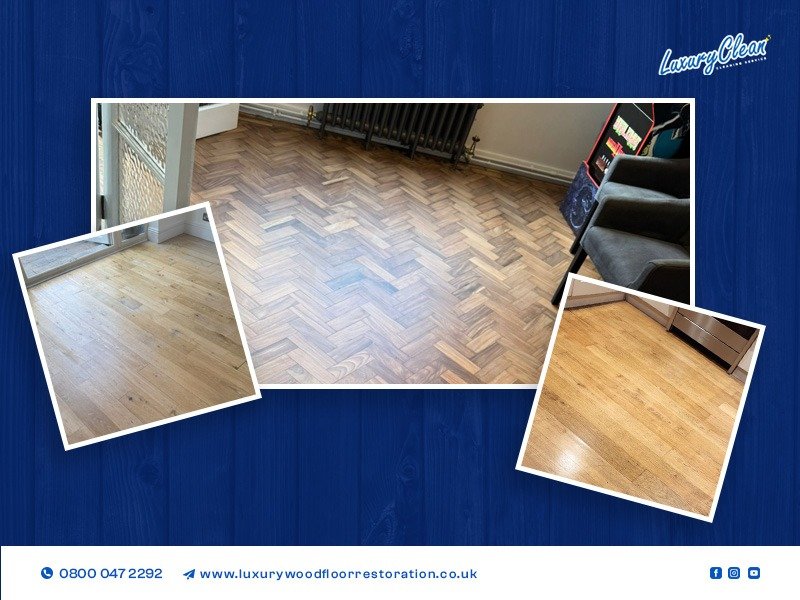
If you need hardwood floor repair in London, the right fix depends on what’s actually damaged: a localised scratch or loose board may need targeted repair, while widespread dullness or patchy colour usually points to sanding and refinishing to restore a uniform look. This guide is for homeowners, landlords, and property managers, especially in areas like Kensington and Mayfair, who want a clear way to choose between repair services and full restoration.
Decide if you need repair, sanding, or full restoration
For a damaged wood floor, there are three paths: repair (fix a specific issue like a scratch or a few damaged boards), floor sanding (even out a worn finish across the room), or restoration (repair first, then sanding/finishing to make everything consistent). Use this decision criterion: if the problem is isolated, repair is often enough; if dullness or marks repeat across the room, sanding is usually the better result; if boards move, gaps return, or multiple issues overlap, restoration is safer.
1. Scratches and scuffs: surface vs deep marks
Surface wear may respond to sanding; deep marks may need filling or board repair.
2. Gaps, creaks and movement: what they usually indicate
Movement can signal a loose floorboard or parquet shifting, fix stability before cosmetics.
3. Damaged boards: signs a board may need replacing
Cracks, lifting edges, or softness can mean replacement, not a patch.
Use the “90-second decision tree” to choose the right service
Use this quick route to choose the most likely service for floor repair in Kensington (and across London) based on your floor type, damage, and the result you want.
Step 1 – Floor type: parquet, engineered wood, solid wood, or original floorboards.
Step 2 – Damage type: scratch/scuff, dent, gaps, loose areas, stained patches, damaged boards.
Step 3 – Scope: one spot vs repeated across the room.
Step 4 – Outcome goal: “good enough in one area” vs “uniform look everywhere.”
If it’s local and stable, repair; if it’s widespread and cosmetic, sand; if it’s moving or repeating, plan for restoration.
Choose the right approach for your floor type (parquet, engineered, solid, original boards)
Your floor type changes what’s possible and what will last, so identify it before booking repair services. A simple criterion: if you’re unsure whether it’s engineered wood flooring or solid wood, avoid assuming it can take aggressive floor sanding.
1. Parquet floors: repairing loose blocks and worn sections
Loose parquet floor blocks often need stabilising before any cosmetic work, especially in traffic areas.
2. Engineered wood flooring: repair limits and careful sanding
Engineered wood can have sanding limits; repairs may focus on targeted fixes and careful blending.
3. Solid wood floors: sanding and board repairs for a uniform finish
Solid wood gives more options for sanding plus board repairs to restore an even look.
4. Original floorboards: preserving character while repairing damage
Older boards may need sympathetic repairs so the finish looks consistent without losing character.
How professional repair services usually work, step by step
Professional services in London typically follow a predictable sequence, which is why results are more consistent than trial-and-error DIY: assessment → preparation → repair method → floor sanding (if needed) → finishing. A key difference is that a specialist chooses the method based on the floor’s condition, not just the visible mark. They’ll also plan practical protections, clearing/covering nearby areas and managing dust, without overpromising a “zero disruption” job.
To speed up diagnosis and get the right proposal, share photos, the floor type (parquet, engineered wood, solid wood, original floorboards), and the location of damage (room + whether it’s local or repeated).
1. Assessment: what a specialist looks for first
They check the wood floor for stability, the extent of wear, and whether issues are cosmetic or linked to movement.
2. Repair methods: filling, stabilising, replacing damaged boards
Depending on the cause, they may fill, stabilise loose areas, or replace damaged boards before any finish work.
3. Finishing: restoring the look after repairs
Finishing is about making repaired areas read as part of the whole floor—sometimes with targeted work, sometimes with broader floor sanding to unify the appearance.
Choose your action and book the right help in London
Choose repair for a single issue, floor sanding when wear is repeated, and restoration when repairs and finishing are both needed. Before you contact a provider, prep: clear photos, floor type (parquet/engineered/solid), a short damage description (scratch, gaps, damaged boards), and approximate room size. During assessment, ask how close the match can be and whether sanding is recommended to unify the finish. If you need hardwood floor restoration in Mayfair, share photos and book an on-site assessment to confirm the method.